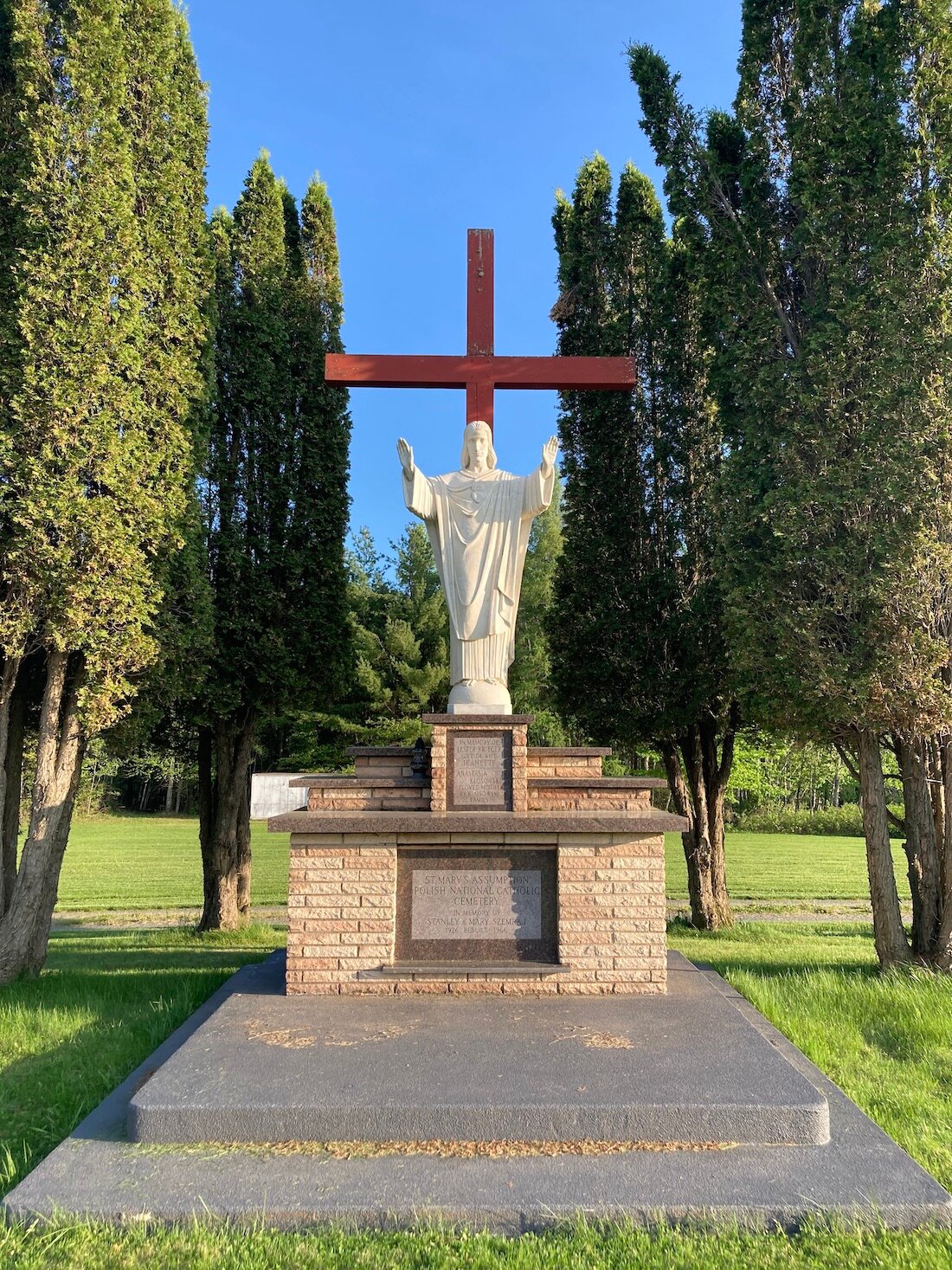


A Lublin church is due to celebrate an important milestone—one hundred years as a church congregation.
St. Mary’s Assumption Polish National Catholic Church, founded officially in January 1926 as a parish of the Polish National Catholic Church (PNCC) and located today at N1235 West Street in Lublin, is hosting a Polka Mass and Polish dinner on Sunday Sept. 14 to mark its 100 year anniversary. The Polka Mass will be held at 10 a.m. with a Polish dinner taking place from 11 a.m. onwards.
Preceded in the area by a Polish independent church movement, St. Mary’s Assumption Polish National Catholic Church at Lublin embraces a long and storied past, being formed by Polish immigrants who came from local Catholic churches looking to preserve their national traditions of language and culture. A parish history written in Polish by Father John Palaszewski and later translated to English shares details on how St. Mary’s Assumption Polish National Catholic Church came to be established at Lublin.
“On Christmas Day, when Calvin Coolidge was the president of the United States and Stanisław Wojciechowski the president of Poland, a telegraph message flashed across the ocean from the right reverend Francis Bonczak, missionary bishop of Poland, to the Most Rev. Francis Hodur, organizer and first bishop of the Polish National Catholic Church, that the Polish police in the town of Jastkowice massacred 217 people who were gathered in their parish church for a mass.
“When the news of the massacre reached the United States of America, in many Polish communities, special meetings were held to demonstrate against the brutality of the Polish police. The Rev. Joseph Lebiedzik Zawistowski, pastor of St. Josephat PNC parish in Duluth, Minnesota, and senior priest of the Northwestern Seniorate, decided to organize a Polish National parish in Lublin, Wisconsin, as a protest against the persecution of National Catholics in Poland. On Jan. 17, 1926, at a meeting chaired by the Rev. John Ziemba, a committee was chosen headed by Mr. Peter Latas. The first organizational meeting was held in the home of Mr. Latas with 62 persons in attendance.
“On March 21, 1926, the Rev. J.L. Zawastowski celebrated a Mass in the home of Mr. Latas, and after the service Father Zawastowski explained the theology of the Polish National Catholic Church. As a result of this meeting, a new PNC parish was organized and accepted under the jurisdiction of the P.N.C. Church. Several of the resolutions were adopted at this meeting, copies of which were sent to the prime bishop at Scranton, Pennsylvania and to the ordinary of the Western Diocese, bishop Leon Grochowski. The document was signed by Rev. Joseph L. Zawastowski and Rev. John K. Ziemba.”
Lublin history materials accessed at sites.rootsweb.com but dating to the 1970s and edited by Linda Kahan, Linda Dubiak, and Rachel Ogorzalek (with many contributors), offer a second account on how the parish came to be established.
“In January of 1926 the Polish National Catholic Church, overcoming many difficulties, came to Lublin. The first service, said by Rev. John Ziemba, was said in the home of Peter Latas…During the rectorship of Rev. A. Radzik, lots for the new church and cemetery were purchased.
“When Rev. J. Siembida became pastor, the plans for the construction of the new church were formed. Working along with Rev. Siembida (were) a committee comprised of F. Kinas, A. Krzypczak, J. Galarowicz, A. Judycki, A. Kaczmarek, W. Sleczka, J. Novak, S. Szemraji, W. Wisniewski, and a special building committee consisting of S. Skrzypczak, J. Majzla, and Mike Staniec.
“In a relatively short time the construction was brought to completion in 1927. The result was St. Mary’s Polish National Catholic Church.”
Started by immigrants who came to the area and bought cutover lumber areas to clear and farm, the first services for St. Mary’s Assumption Polish National Catholic were held in private homes, prior to completion of the church building. A rectory and cemetery were soon added as well, the rectory built on land donated by Raymond Dobrzanski. A Lady’s Society for Adoration of the Most Blessed Sacrament was also founded, to aid in the spiritual and material growth of the parish. The church building itself was dedicated by the Rt. Rev. Leon Grochowski of Chicago, Illinois on August 15, 1928 (one record says 1929).
Serving the congregation for just over 27 years, the original church building for St. Mary’s Assumption Polish National Catholic was completely destroyed by fire on December 19, 1956. Parishioners set out to build a new brick church almost immediately, buoyed by aid from other PNCC parishes. The congregation held services in St. Mary’s Greek Orthodox Church (also at Lublin) until the new church building was completed. The 1957 church building continues to serve the congregation today.
The building committee for the 1957 church was composed of John Szemraji, Louis Luzinski, Ed Fryza, Mary Novak, Wanda Losiewicz, Jess Bandor, and Teodosia Burzinski. Other church members deemed important to construction of the new church building included Walter Staniec, Donald Syryczuk, Stanley Pawlowicz, Walter Ruda, Frank Knusta, Edwin Judycki, Mike Novak, Frank Zuber, and Steve Shewczyk. In 1965 a new rectory was built as well to replace the old one. The home of Peter Latas where the first organizational meeting and mass were both held, has since burned down.
PNCC priests serving at St. Mary’s Assumption Polish National Catholic over the years meanwhile have included the following: Rev. John Siembida, Rev. Joseph Bronski, Rev. Francis Wozniak, Rev. Martin Dymsza, Rev. P. Williamowicz, Rev. Phillip Kedzierski, Rev. John Palaszewski, Rev. Stanley Tyrbuski, Rev. Leon Dobrzanksi, Rev. Martin Wachna, Rev. Anthony Matla, Rev. A. Hering, Rev. Hearst, Rev. Matthew Buba, Rev. Roman Misiewicz, Rev. Thomas Falkowski, Rev. Stephen Krawiec, Very Rev. Edward Brzostowski, Very Rev. Henry Meus, Rev. John Kutek, Rev. Alan Bemis, Rev. Witold Victor Laugalis, and Rev. Marion Talaga.
As the name suggests and touched on briefly above, St. Mary’s Polish National Catholic Church at Lublin is affiliated with the Polish National Catholic Church (PNCC), an Old Catholic church headquartered at Scranton, Pennsylvania. The Old Catholic Church refers to a group of churches formed after Vatican I and the Union of Utrecht, established by European Catholics who rejected papal infallibility. The PNCC traces its beginnings to March 2, 1897, when it was organized as a separate church body.
Not in union with Rome as a result, the PNCC traces its claim to apostolic succession via the ordination of its organizer and first prime bishop Father Francis Hodur as a bishop by Old Catholic bishops at Utrecht in the Netherlands. Hodur had been ordained as a Catholic priest in 1893 before being excommunicated in 1898 after helping his parishioners set up a church government model they had known from Poland and refusing to submit to his bishop, as well as challenging both papal infallibility and supremacy. Hodur read the excommunication letter to his congregation before later burning it and throwing the contents into a nearby brook. The PNCC is today part of the Union of Scranton, established in the 2000s after the Union of Utrecht was deemed to have strayed from both Holy Scripture and Sacred Tradition in some of its practices.
Organized in a time when the U.S. Catholic hierarchy sought a unity sometimes defined in terms of uniformity with Poles themselves looked down on, historical information on the organization of the PNCC is available in “The Polish National Catholic Church” by Paul Fox, as well as on the PNCC website at https://pncc.org. Organized originally into three dioceses, the PNCC later sent Francis Bonczak to Poland as a missionary bishop after World War One to found the Polish Catholic Church (PCC) in a then newly independent Poland, emerging from centuries of outside domination.
As for the PNCC stateside, it is organized at present into five dioceses. Church government in the PNCC involves parish meetings and a committee, as well as a pastor, appointed by the bishop to guide the church. The prime bishop is considered to be “first among equals,” working in concert with the other bishops, with church government operated on a synodal model. The first synod was held on September 6, 1904 at Scranton.
Church property within the PNCC is owned by congregation members (as opposed to the diocese) and polity is ultrajectine, meaning that congregations control their own affairs. Members of the PNCC are united in both their profession of the Trinity and Jesus’ role in salvation among other beliefs, the church’s symbol containing a Bible, sun, cross, and palm while declaring “Truth (Prawdą), Work (Pracą), and Struggle (Walką).” The PNCC’s motto states “with truth, work, and struggle, we will succeed.” Like Rome and Orthodoxy the PNCC affirms seven sacraments, also counting the written Word of God as a sacrament.
Historically associated with Polish immigrant communities, the PNCC today welcomes people of all ethnic, racial, and social backgrounds. In contrast to mainstream Roman-rite Catholicism, meanwhile, PNCC clergy can marry, similar to the Anglican Ordinariate and Eastern-rite Catholic Churches under Rome.
Now 100 years old as a congregation and served at present by the Rev. Marion Talaga, St. Mary’s Polish National Catholic Church at Lublin holds two monthly services, one on the second Saturday and another on the fourth Saturday of the month, both at 10 a.m. The congregation also has a presence on Facebook at St. Mary’s Polish National Catholic Church, welcoming community members to its 100 year anniversary celebration on Sunday, September 14 at Lublin. A Polish dinner including golbaski (cabbage rolls), polska kielbasa (polish sausage), and kapusta (kraut) will be served from 11 a.m. onwards, along with all the trimmings, with carryouts available. A Polka Mass will precede the dinner at 10 a.m.
St. Mary’s Assumption Parish contact for more information is Ray Soper at 715-965-5175.